New Digital Mode App EXChat

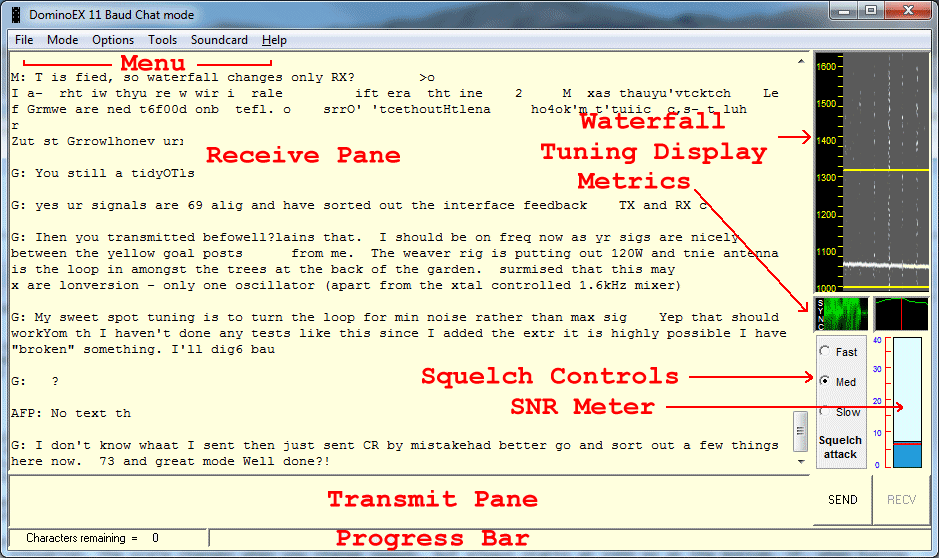
Con Wassilieff ZL2AFP has developed a sentence-mode radio chat system that works like phone texting!

This is a computer program for Amateur Radio transmission and reception using a computer and radio transceiver. The program equips your computer with a one sentence at a time chat-mode for operation on the HF bands. You use it in the same way as you would Skype™ or cell-phone TXTing. This facilitates rapid-fire QSOs and especially makes nets easier.
Digital_mode_App_ExChat

As usual, sound card techniques are used to generate transmissions using tones at audio frequency, and to receive and decode the incoming signals, also at audio frequency. An SSB transceiver translates these signals to and from the HF Amateur Bands.

The EXChat mode is a development of DominoEX, and is completely compatible with other DominoEX versions. In fact operators without EXChat, but who have another version of DominoEX, can take part in a QSO, if in a slightly clumsy manner. What is different about EXChat is that it operates in Sentence Mode.

Read more about EXChat and download - http://www.qsl.net/zl1bpu/MFSK/EXChat.htm


A history of the Darwin transmitter

Veteran Melbourne DXer and historian, Bob Padula, has compiled a history of Radio Australia's former Darwin transmitting and receiving sites in a new electronic (PDF) publication.

In it, he timelines the developments of the station, highlighting the relationship between the site and the city of Darwin’s own recent history. Some very interesting photographs have been sourced as well.

Mount Evelyn DX Report - http://medxr.blogspot.com.au/2014/11/radio-australia-darwin-transmitter-many.html


OSCAR Locator App

Tom Doyle W9KE has developed a Windows satellite tracking App that reproduces the graphical display of the original cardboard OSCARLOCATOR

Most tracking programs use an equirectangular projection which is by far the easiest to program and shows the entire Earth at once. A 3D model is often used which helps visualize orbits but does not show the entire Earth at the same time.

Tom remembers having an easier time visualizing the orbits back in the day (1970's) when amateurs used cardboard Oscar Locators with overlays. This Windows program lets you visualize orbits Oscar Locator style.

You can download the OSCAR Locator - http://www.tomdoyle.org/OscarLocator

40 Years of Tracking OSCAR-7-  http://amsat-uk.org/2014/11/09/40-years-tracking-oscar-7/