Cansat - Rocket Launched Instruments in a 330ml Can

A CanSat is a "satellite" of the size of a soft drink can. This mini-satellite is designed, constructed and programmed by high school students. The CanSat is then launched to an altitude of a few hundred meters by a rocket. While descending back to earth with a parachute, the satellite carries out measurements and scientific experiments.
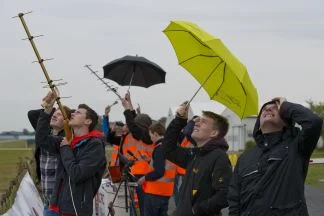
The CanSat competition is a simulation of a real space mission, including all relevant phases like selecting and planning the mission, fundraising to financially support the mission, designing and constructing the satellite, testing the components, preparing for launch, analyzing the data and communicating the results to the public. The CanSat competition offers motivated and talented students a unique opportunity to gain first practical experiences with a real space project.
The German CanSat competition cooperates with the international CanSat competition organized by the European Space Agency (ESA). Each winning team of the German CanSat competition will go on to participate in the European competition.

More information - http://cansat.de/competition.html


New Open Source Data Mode FSQ

Con Wassilieff ZL2AFP has developed a new fast simple chat data mode for use on HF and VHF 

FSQ is a Fast Simple QSO mode for MF/HF. It works well under NVIS and sunrise/sunset conditions on the lower bands, and also works well for short skip on higher bands. It can also be used on VHF FM, and clearly has a much wider useful range of operating conditions that other more conventional digital modes. Sending speed can be varied between 20 and 60 WPM.

Screenshot of the ZL2AFP FSQCALL software with FSQCALL turned off

FSQ is designed for simple but effective 'Chat' operation, rather like phone text messaging or Skype™ chat; fast and easy to use. You don't use 'overs' as you would with a conventional digital or voice mode. It is highly suited to net operation. You just type a sentence and press Enter. 

An important factor in the design of FSQ is that no synchronising process is required to locate and decode the received characters. Lack of sync means that reception is much less influenced by propagation timing changes that affect almost all other modes, since timing is quite unimportant; it almost completely eliminates impulse noise disruption; and it also contributes to very fast acquisition of the signal (decoding reliably within one symbol of start of reception). Fast acquisition removes the need for addition of extra idle characters at the start of transmission, and this leads to a very slick system. Add high resistance to QRM and QRN, thanks to the low baud rate, and you have a system so robust that it does not need error correction. 

Sensitivity is believed to be about -13 dB SNR at 6 baud, and -16 dB SNR at 3 baud. That's about 10dB better and several times faster than 12 WPM Morse. 

FSQ is NOT compatible in any way with EXChat or DominoEX. While also a Chat mode, it uses a completely new and revolutionary protocol.

FSQ - http://www.qsl.net/zl1bpu/MFSK/FSQweb.htm

Direct download link - http://www.qsl.net/zl1bpu/SOFT/FSQCALL.zip

D-STAR, DMR and C4FM Repeater Maps

Radio amateurs use at least five different and incompatible amateur radio digital voice modes on the VHF/UHF bands, D-STAR, Motorola's DMR, dPMR, Yaesu System Fusion C4FM and FreeDV

FreeDV

Of those D-STAR, DMR and C4FM have widespread repeater networks and there is currently one dPMR repeater GB7RR.

Yaesu supply the DR-1XE dual band repeater which can operate in both Digital SystemFusion (C4FM) mode and the traditional Analogue FM mode. It features an Automatic Mode Selection function.

FreeDV was initially developed for HF but is now being used at VHF as well. It is a free software solution for digital voice making use of your PC's soundcard, see

Maps showing the D-STAR, DMR and C4FM repeaters are available on the UK Repeater website.

FreeDV - http://freedv.org/

D-STAR Repeater map - http://www.ukrepeater.net/d-star.htm

DMR Repeater Map - http://www.ukrepeater.net/dmr.htm

Yaesu System Fusion C4FM Repeater Map - http://www.ukrepeater.net/fusion.htm