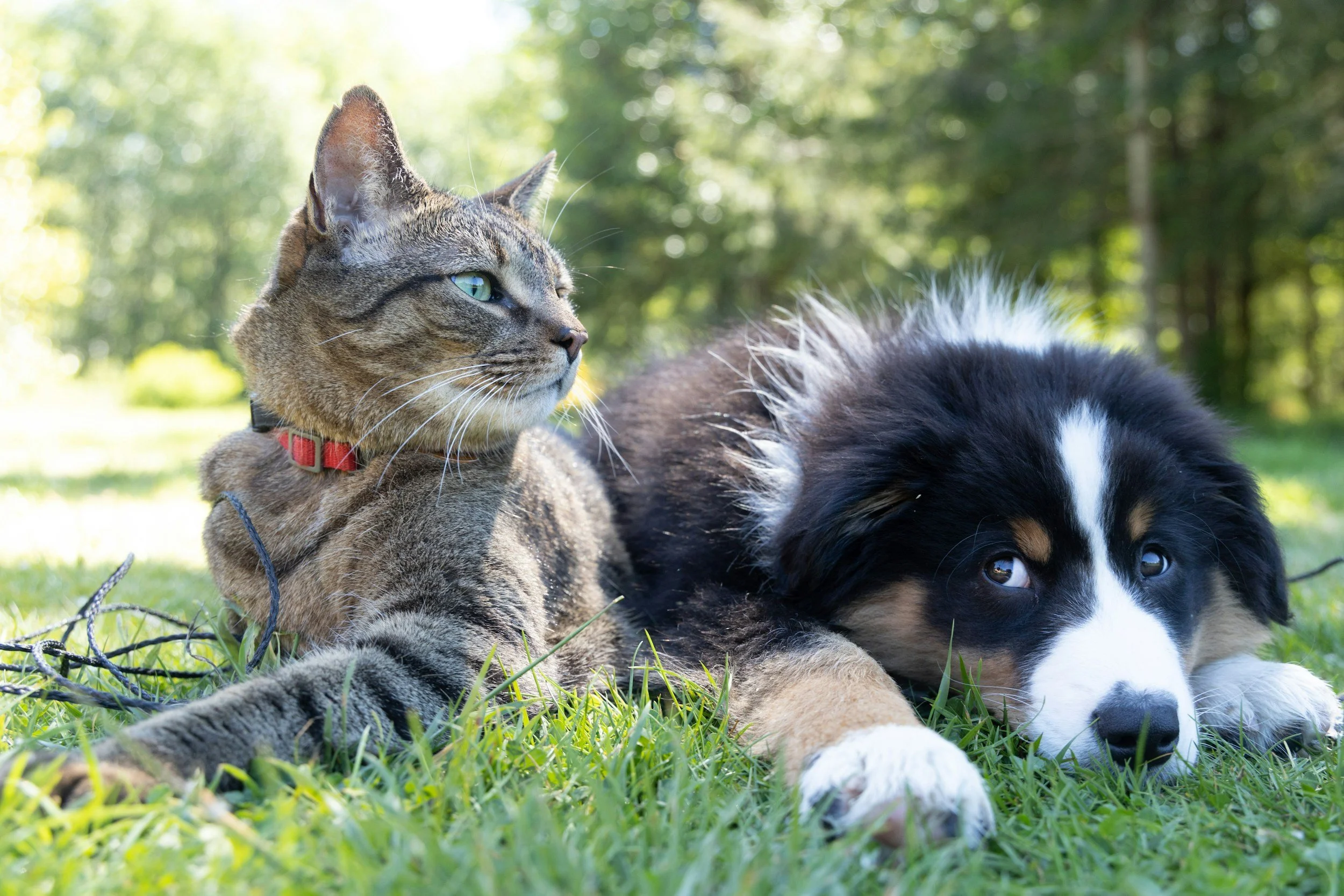
International Dog Day and International Cat Day Special Event

International Dog Day and International Cat Day Special Event

An international group of operators will be on the air throughout the month in a mutual celebration of International Cat Day and International Dog Day.

The combined special event stations will be active from the 1st of August through to the 31st of August, to call attention to the needs of abandoned, abused and homeless pets around the world – and to advocate for adoption and humane treatment. In the spirit of friendship and the shared love of animals, they will be looking to raise awareness and hear one another’s stories.

The hams calling CQ are animal-lovers themselves who know the power of rescue because many have been deeply involved in organised animal-welfare efforts or have included a rescued dog or cat in their family.

Read More

HAMgpt Launches as an AI Assistant Built Around Your Station

A new AI assistant aimed specifically at radio amateurs has opened to the public. HAMgpt is built by Rodrigo Vazquez, AK6FP / LU6ERV, and sets out to answer one question: what can I actually do with my radio today?

The difference from a general chatbot is context. Operators can save a station profile — licence class, country, grid square, the exact radios and antennas they own, plus imported ADIF logbook data — and HAMgpt reuses it across conversations. That profile is then combined with live propagation, space weather and DX activity, so answers are tied to a specific station rather than being generic.

In practice that means suggesting which nearby repeaters are realistically workable with a given handheld, including offset and tone; recommending HF bands that are open and covered by the antennas actually installed; predicting satellite passes suited to the operator's gear; and finding nearby POTA parks.

There is a substantial antenna-building layer too. HAMgpt will produce build sheets for dipoles, inverted-Vs, verticals, Yagis, Moxons and magnetic loops, with element lengths, spacing, matching options and to-scale diagrams generated in the chat. Operators can also upload a NanoVNA .s1p file and get an SWR plot with a plain-language reading of it, or photograph an analyser or rig display for interpretation.

Other features include model-specific help for rigs from Yaesu, Icom, Kenwood, Elecraft, FlexRadio, Xiegu and others, step-by-step Winlink Express setup, and the official NCVEC practice question pools for all three US licence classes.

Because amateur radio is a regulated service, the developer has taken a "deterministic-first" approach: licence privileges, band plans, exam questions and live band data come from structured tools and official sources rather than being generated, with the AI layer used for interpretation and troubleshooting. Licence class is treated as a hard constraint throughout.

Support is not US-only. Licence-aware guidance is available for the United States, Canada, the UK, Australia, Japan and Argentina, with help on CEPT, IARP and visitor permits for those operating abroad. The assistant works in English, Spanish, Italian, Portuguese, French and German among other languages.

HAMgpt is a sister project to DXLook, the live propagation and activity platform by the same developer, which supplies its real-time data. There is a free, ad-free tier with daily limits, and a paid Plus tier with higher limits and deeper personalisation. Neither carries advertising.

More Information - http://www.hamgpt.co
Keeping Teams Connected Where the Network Isn't

For emergency services, energy companies and anyone working in remote locations, reliable communication isn't a convenience — it's a basic operational requirement. The problem is that the infrastructure most organisations rely on is the first thing to fail when conditions get difficult.

Cellular dead zones are an obvious issue: large parts of the world simply have no coverage, and a team working beyond the last mast has no way of reaching anyone. Less obvious is what happens in a disaster. Storms, floods and wildfires take out power and backhaul, and cell sites go dark precisely when they are needed most. Cyberattacks on utility and telecoms operators can produce the same result without a cloud in the sky.

There is a second, quieter problem. Organisations tend to accumulate communication systems over time — a DMR fleet here, a handful of analogue handhelds there, a dispatch console that talks to neither. When an incident brings multiple teams together, those systems don't interoperate, and responders end up in communication silos, unable to talk to the people standing next to them.

Satellite push-to-talk has become one of the more practical answers to both. Because the network is overhead rather than on the ground, coverage is effectively global and doesn't depend on local infrastructure surviving the event. Modern satellite PTT radios operate much like a conventional handheld — press the button, talk to the group — so there is little retraining involved.

Crucially, they can also be gatewayed into existing LMR, IP and dispatch systems rather than replacing them. That turns a collection of separate networks into a single unified talk group, so a field crew on satellite, a control room on IP and a local team on DMR are all in the same conversation.

Several manufacturers now offer satellite PTT handsets and gateway solutions, and it's worth looking at how any given system integrates with the equipment you already run — the integration is usually what determines whether it actually solves the silo problem.

ICom Opinion -https://icomuk.co.uk/Satellite_PTT_Robust_Comms_for_Remote_Ops/4159/5588/#